
Securing Minerals for the Energy Transition: Finance for Southern Africa
The World Economic Forum (WEF) recently published its “Securing Minerals for the Energy Transition: Finance for Southern Africa” White Paper, setting out a significant imbalance between the Southern Africa’s resource wealth and its levels of investment flows. The region holds nearly 30% of the world’s proven critical mineral reserves, yet attracts less than 10% of global exploration funding. The White Paper, which was developed alongside the Development Bank of Southern Africa (DBSA) and McKinsey, sets out why this gap is important and what could be done to minimize it.
A widening gap between resources and investment
In 2024, exploration expenditure in all of Africa stood at USD 1.3 billion, accounting for only 10.4% of the global amount. Australia and Canada, by contrast, received USD 2 billion and USD 2.5 billion respectively (16% and 20%), despite holding reserves that are far less diverse than those find across Southern Africa.
The reserves-to-production ratio, which provides a sense of how long a country’s reserves could last at current rates of production, provides a similar story. Among the most striking examples in the report, Tanzania’s graphite reserves could sustain around 720 years of production at 2024 rates, compared with just 188 years in South Korea. A similar contrast appears in chromium: Zimbabwe’s reserves could support roughly 491 years of production, whereas Brazil’s will last only five years.
Selected reserves-to-production ratios: Southern Africa vs global peers. Years of potential production at 2024 production rates
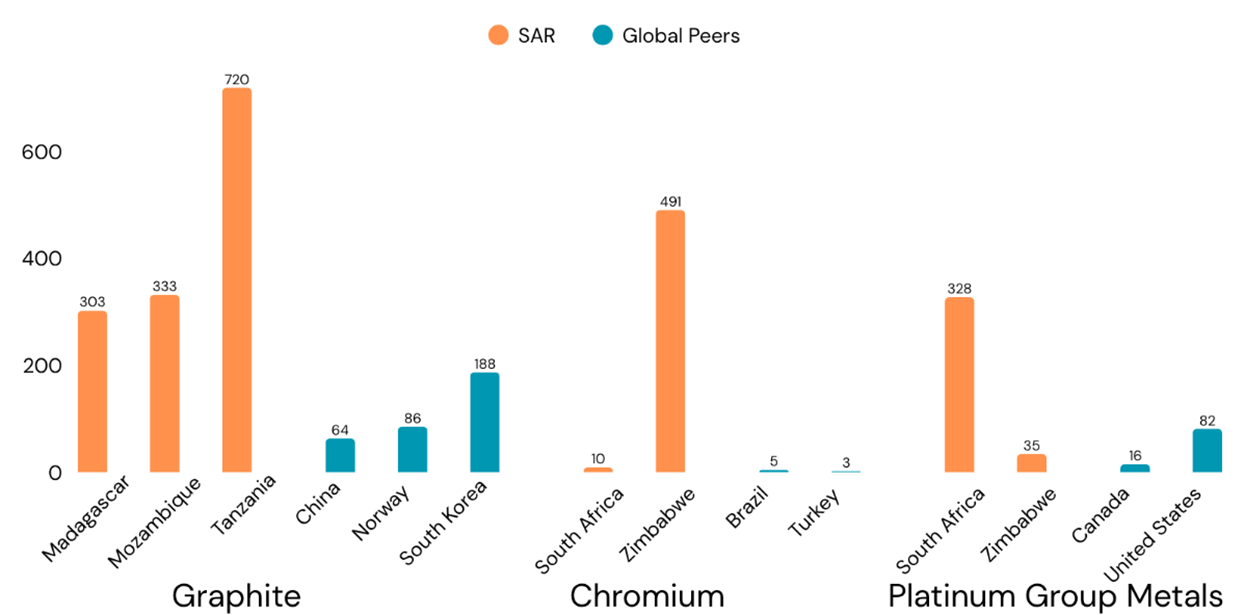
Source: Adapted from World Economic Forum, DBSA and McKinsey (2025), Securing Minerals for the Energy Transition: Finance for Southern Africa. Original data: US Geological Survey.
Why the capital gap persists
The White Paper attributes this underinvestment to a combination of structural constraints. Notable, this includes:
- Policy uncertainty: unclear laws that deter investors from making any commitments.
- Investment risk: only 2.8% of USD 17 billion in specialist mining private equity capital globally is dedicated to Africa.
- Energy access: power cuts of up to 18 hours per day in Zimbabwe adversely affect mining.
- Transportation barriers: 100-kilometer-long truck lines at the borders and two-weeks-long waits.
- Innovation lag: “materials” account for less than 1% of African venture capital investments.
- Pace of industrialization: Africa manages to retain only 4-20% of the mineral value it produces since most of it leaves unprocessed.
- Skill deficit: only 14% of South Africa's mining workers are post-matriculation graduates.
- Demand volatility: lithium prices reached their four-year low point in February 2025.
Together, these factors reinforce investor perceptions of risk and help to frame the reasons why capital continues to flow elsewhere.
Solutions are already taking shape
To highlight how different solutions are currently being implemented, the White Paper describes eight case studies showing how these barriers are being addressed in practice. Three stand out as particularly relevant to the region's energy and minerals outlook:
- Zambia has taken a deliberate approach to making its mining sector more investor-friendly. Between 2022 and 2024, the country passed a new mining policy, reformed its tax regime and centralized license regulation. By 2031, Zambia wants to produce 3 million tonnes of copper from the current 700,000 tonnes. Already in 2026, 1 million tonnes are projected, with commodity trader Mercuria set to become the strategic partner.
- In the Democratic Republic of Congo, a locally led financing structure has helped bring a major project to fruition. Rawbank helped structure the financing for the Kamoa-Kakula project, incorporating international ESG standards and DRC local-content requirements into the deal. As part of the deal, Rawbank brought Congolese suppliers into the project, helping to meet rules designed to keep more mining activity and value within the country.
- The Lobito Corridor is turning an old railway into a key regional link. The Lobito Atlantic Railway links Angola’s port of Lobito to the copper belt in the DRC, with a second phase (an 800-km greenfield extension) planned to reach landlocked Zambia. Backed by a public-private partnership including Angola, the DRC, Zambia, the EU, the US and the AfDB, with DBSA approving USD 200 million in funding alongside the US DFC, the corridor shows what shared infrastructure can look like when it is approached as a regional project rather than a single-country one. By creating a faster, more efficient route to global markets, it could cut transport and logistics costs and improve the economics of mining projects across the Copperbelt.
The report is clear that no single measure will close the investment gap, the solutions will need to adapt to specific local requirements. Blended finance can help reduce risk for early-stage investors, shared infrastructure such as the Lobito Corridor can lower costs and improve project economics, and long-term agreements with buyers can give investors greater confidence that there will be a market once production begins. Clearer regulation, stronger local skills and greater investment in processing and innovation also form a critical part of the picture.
Southern Africa’s mineral wealth is evident. The task ahead is to mobilize the capital and enable the partnerships that are needed to convert the potential into lasting economic value for the region’s mining sector and for the broader energy transition it is positioned to support.
Add New Comment