
17 ACTIONS FOR ENSURING MINIGRIDS CATALYZE ELECTRIFICATION IN SUB-SAHARAN AFRICA (Mission 300 Position Paper)
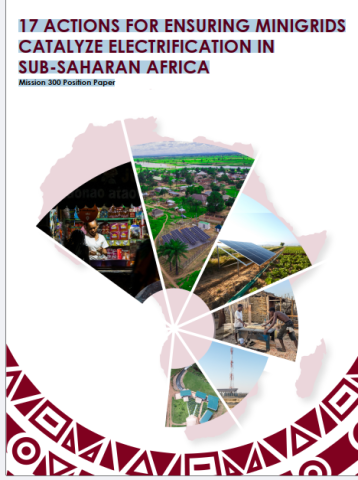
The white paper, “17 Actions for Ensuring Minigrids Catalyze Electrification in Sub-Saharan Africa”, aims to provide a practical, action-oriented roadmap for scaling minigrids as a central solution to achieving universal electricity access under the Mission 300 (M300) initiative. It seeks to align governments, private sector actors, financiers, and development partners around urgent, coordinated interventions needed to accelerate minigrid deployment at an unprecedented scale.
The paper highlights that solar minigrids are the most cost-effective solution to electrify up to 380 million people in Sub-Saharan Africa, yet current deployment rates fall far short of what is required. While about 160,000 minigrids (requiring ~$91 billion) are needed, only a fraction will be delivered by 2030 under a business-as-usual scenario.
To bridge this gap, the paper proposes 17 priority actions structured across three core pillars:
- Capital Mobilization – Calls for significantly scaling financing through blended instruments (equity, debt, subsidies), expanding local currency financing, and frontloading capital deployment. It estimates $28–46 billion is needed to deliver 23 million connections via minigrids.
- Industry Capacity – Emphasizes the need to increase deployment capacity by over 200 times, through standardization, modular system design, workforce development, and adoption of digital/AI solutions. It also highlights the importance of productive use of energy (PUE) to improve project viability.
- Government Enabling Environment – Stresses the urgency of clear and stable regulatory frameworks, cost-reflective tariffs, streamlined permitting, and large-scale procurement mechanisms to enable rapid rollout. Governments are urged to act as facilitators rather than constraints to private investment.
Additionally, cross-cutting enablers include strong monitoring systems, transparency, and integration with adjacent sectors such as agriculture, telecoms, and e-mobility to maximize development impact.
Overall, the paper underscores that achieving Mission 300 requires a shift from incremental progress to industrial-scale deployment, backed by coordinated action, significant capital mobilization, and systemic reforms across the ecosystem.
Add New Comment