
Sharing Regional Transmission Costs Equitably: Design Lessons from the West African Power Pool

Introduction
Cross-border transmission lines are among the most valuable assets in a regional electricity market, and among the hardest to finance. They let countries draw on cheaper or cleaner generation beyond their borders, share reserves and improve reliability, and the economic gains can be large. In the Middle East and North Africa, for example, World Bank analysis of the Pan-Arab Electricity Market found that every USD 1 billion invested in regional cross-border infrastructure could yield USD 4.6 billion in power system cost savings. Yet investment remains far below need, particularly in sub-Saharan Africa, and a recurring obstacle is the question of who should pay for shared assets. Regional assets include interconnectors and transmission corridors inside individual countries, so the country hosting a line is rarely the only one using or benefiting from it. Unless participating countries know their obligations, and transmission owners are confident that approved costs will be recovered, projects with clear regional benefits can stall.
A recent reform in the West African Power Pool (WAPP) shows how one region has approached this question. In 2026, the ECOWAS Regional Electricity Regulatory Authority (ERERA) formally adopted a new Regional Transmission Tariff Methodology and its application procedure, replacing a transaction-based approach with one based on network use. The methodology is now in a transitional implementation phase, so its results cannot yet be judged. Its design, however, already shows how a power pool can balance three objectives that often pull apart: cost-reflective allocation, predictable revenue for transmission owners, and a transition that countries whose revenues change are willing to accept. The reform is also relevant to Mission 300, the World Bank Group and African Development Bank initiative to connect 300 million people in Africa to electricity by 2030, whose National Energy Compacts commit countries to regional integration and stronger utilities. Much of the analysis below draws on a peer-reviewed study of the reform by Elabbas et al. (2026), whose authors, from Comillas Pontifical University, the Fondazione Eni Enrico Mattei and the Tony Blair Institute for Global Change, took part directly in the revision as technical and policy advisers to WAPP and ERERA.
What equitable cost allocation should achieve
A broad consensus has emerged on the principles that regional transmission cost allocation should follow. Once a line is built, its cost is largely fixed and is recovered as a regulated annuity, whatever volume of electricity it carries. Charges should therefore reflect the benefits countries receive or their use of the network, not the commercial contracts behind individual trades, because electricity flows according to network conditions, regardless of the contractual path between buyer and seller. Allocation should not distort dispatch or discourage economic trade, and it should be made at country level, leaving each national regulator to decide how its share is recovered from domestic users.
“Benefits” and “use” are distinct principles and can produce materially different results, so their roles need to be clear. For a new project, the cost-benefit analysis conducted for its regulatory approval can identify who gains, supporting a negotiated, beneficiary-pays allocation. Where benefits are too uncertain to quantify, or negotiation fails, costs should be allocated according to expected network use under a method agreed in advance. For existing assets, whose original beneficiaries can no longer be meaningfully identified, usage-based allocation or socialization is the practical choice. Usage is therefore both the default for the shared network and the fallback for new projects.
Why WAPP moved away from transaction-based charges
WAPP’s original method reflected the way its market began, with trade developing through bilateral contracts tied to dedicated interconnections, starting with exports from Ghana’s Akosombo dam to Togo and Benin. In August 2015, ERERA’s Regulatory Council adopted a “point-to-point MW-km load flow-based tariff methodology” calculated for each regional bilateral trade, following the approach the Southern African Power Pool (SAPP) had adopted 12 years earlier.
Since then, the region’s grids have been progressively interconnected and synchronized: WAPP synchronized the grids of 12 West African countries in July 2023, with Nigeria and Niger to follow; Nigeria’s grid ran synchronized with the regional system for four uninterrupted hours in November 2025, and full synchronization of all interconnected systems was still being completed in 2026, as the region moves towards competitive trading over a meshed network. A comparative quantitative assessment carried out for the revision found that the MW-km method not only conflicts with sound allocation principles but also systematically over-charges regional bilateral transactions and cannot support a competitive regional market.
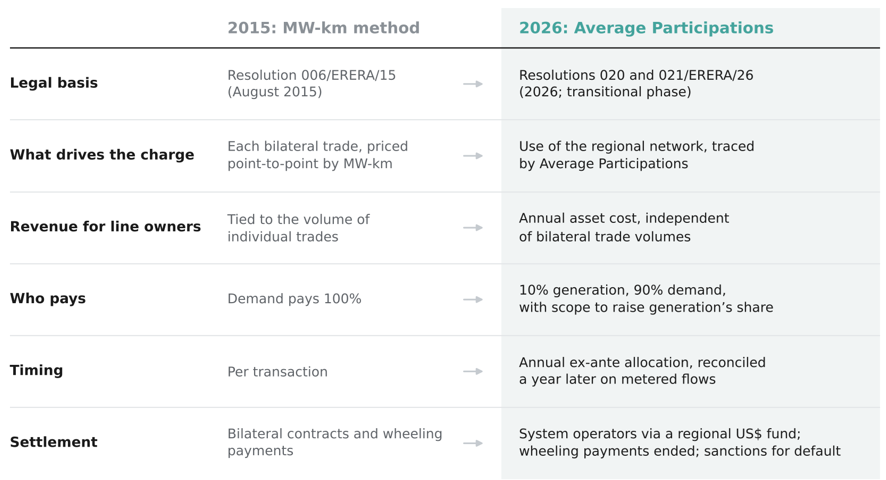
The revised framework uses the Average Participations method, which traces actual or expected power flows to attribute the use of each regional asset to generators and consumers in each country. The annual cost of regional transmission assets is then allocated independently of the volume of individual bilateral trades. This removes the volume risk that transmission owners and their lenders carried when revenue depended on how much a particular trade used a line. The new methodology also formally ends bilateral wheeling payments, the usual source of stacked, or “pancaked”, charges when trades cross several systems.
How WAPP’s regional transmission cost allocation changed between the 2015 and 2026 methodologies
Source: ERERA Resolutions No. 006/ERERA/15, No. 020/ERERA/26 and No. 021/ERERA/26; Elabbas et al. (2026).
Because allocations depend on assumed flows, WAPP determines each year’s compensation from the expected operation for the following year, then reconciles it a year later against metered flows and actual operation. Reconciliation is therefore an integral part of the design, giving countries confidence that they pay for the network they actually use, although utilities must budget for the resulting adjustments. A common definition of eligible regional assets and consistent asset valuation, with other revenues such as congestion rents taken into account, are needed to prevent over-recovery. How transmission losses caused by regional flows are treated is a further question that implementation will need to settle.
The split-key is where technical design meets political economy
Network usage shows how much of the system each country uses, but not how that cost should be divided between the generators that inject power and the consumers that withdraw it. Because power flows originate in generation and end in demand, both sides use the network, and an equal split is the technically neutral starting point. The final choice, however, is a regulatory decision with distributional consequences.
National positions tend to follow trading positions, as net exporters, often endowed with low-cost generation, favor allocations that minimize their own burden; net importers prefer to place more of the cost on exporters; and countries that host transit flows look for compensation for wheeling. Within each country, governments must also weigh the interests of generators, consumers and utilities. Without agreed principles, choosing a method can become an open-ended negotiation over distributional outcomes.
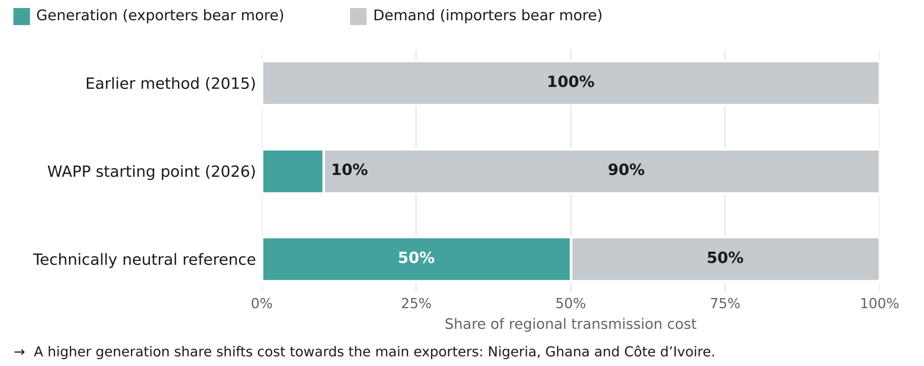
In WAPP, the earlier method placed the full cost on demand. Sensitivity analysis during the revision showed that raising the generation share would shift a larger proportion of regional costs to the main exporters, notably Nigeria, Ghana and Côte d’Ivoire, and that moving straight to an equal split would substantially alter existing revenue streams. After several split-keys were tested and discussed with members, regulators and utilities, stakeholders agreed to begin with 10% of costs allocated to generation and 90% to demand, with the generation share potentially rising over time. The starting point was the highest share at which exporters’ current revenues would not be significantly disrupted.
Split of regional transmission costs between generation and demand
Source: ERERA Resolution No. 020/ERERA/26 (2026); Elabbas et al. (2026).
WAPP and ERERA carried out the comparative assessment of methods together, so regulatory considerations shaped the analysis rather than being applied after a proposal was submitted. Successive consultations with national utilities, regulators and development partners then tested the distributional effects of each option before decisions were taken, which helped build acceptance of the outcome.
Making the allocation collectable and financially credible
An allocation formula matters only if the resulting payments are made, and WAPP’s institutional set-up has helped in this respect. ERERA has statutory and quasi-judicial powers to adopt regulations that apply directly across the ECOWAS region, so the revised methodology did not need separate approval by each national regulator; instead, the WAPP Board approved the proposal and ERERA’s Regulatory Council adopted it. Few African power pools have comparable regional authority.
ERERA’s authority rests on ECOWAS law, which matters for Burkina Faso, Mali and Niger. The three countries withdrew from ECOWAS in January 2025 but remain WAPP members, and Burkina Faso and Niger have Mission 300 Compacts. How the new methodology will apply to them is still to be settled, for example through agreements within WAPP, and settling it early will support regional projects such as the North Core line that is to link Nigeria with Burkina Faso through Niger.
Under the new framework, WAPP executes the methodology and calculates obligations, ERERA oversees execution and payments, resolves disputes and can impose sanctions, national regulators adjust domestic tariff revenue to reflect regional compensation, and national system operators act as the compensation parties that pay or receive. Payments are to be settled through a common regional fund denominated in US dollars, which simplifies multilateral settlement and protects recipients from exchange-rate risk, although it leaves payers whose revenues are in local currency to carry that risk. Article 11.9.3 of the new methodology provides for payment defaults to be dealt with through sanctions from the regional market. Interconnectors financed through special-purpose vehicles, such as the Côte d’Ivoire-Liberia-Sierra Leone-Guinea line, remain within the common allocation method, while project-specific contracts govern the recovery of their investment costs.
The change is significant for lenders because, under the old method, an interconnector’s revenue depended on how much individual contracts used it, whereas under the new one the regulated annual cost of regional assets is recovered from all users of the network. Cash flows become more predictable, even though annual reconciliation introduces some uncertainty about which countries pay how much. Because regional transmission in Africa relies heavily on concessional finance, guarantees and blended structures, this predictability contributes directly to the bankability of future interconnectors.
Payment reliability nonetheless depends on national revenue collection, and in several member states tariffs remain below cost-recovery levels. During the transition, compensation is to be handled by designated national entities, currently incumbent transmission operators and vertically integrated utilities. In the largest systems, however, transmission and system operation are unbundled from distribution, with Nigeria’s Transmission Company (TCN) and the Nigerian Independent System Operator (NISO), admitted to WAPP in January 2026, and Ghana’s GRIDCo, so regional payments will depend on revenue passed through from distribution companies. Nigeria, the region’s largest market and exporter, therefore carries much of the payment risk, and its cross-border sales already show it: Nigeria’s regulator reported that neighboring utilities paid less than half of the cross-border electricity invoiced in the second quarter of 2026. The framework addresses default through sanctions but does not yet set out how a shortfall would be covered in the meantime, although WAPP is establishing a Liquidity Enhancing Revolving Fund as a collective guarantee mechanism. Legacy bilateral contracts and transmission service agreements must also be phased out without double charging, and Nigerian rules requiring transmission charges on exported power, for instance, required separate discussions with the national regulator. Metering, settlement systems and annual reconciliation add administrative costs for utilities with limited capacity.
The transitional period should therefore be treated as a live test, with priorities including stress-testing compensation cash flows under different operating and payment scenarios, publishing a clear compliance and sanctions procedure so that utilities and lenders can price counterparty risk, preparing metering, settlement and revenue ring-fencing for annual reconciliation, and publishing a mid-transition review of allocation accuracy, reconciliation adjustments, payment timeliness and defaults. None of these measures has yet been tested in practice.
How the reform supports Mission 300
Mission 300 relies on National Energy Compacts in which governments commit to specific reforms and investments. Twelve of the 14 interconnected WAPP countries have published Compacts: Benin, Burkina Faso, Côte d’Ivoire, The Gambia, Ghana, Guinea, Liberia, Niger, Nigeria, Senegal, Sierra Leone and Togo. Of the Compacts’ priorities, the RTCA reform bears most directly on regional integration and on the financial viability of utilities. The RTCA reform was not an AfDB operation, but it matters to the Bank’s portfolio. AfDB co-financed interconnectors that the new methodology now covers, including EUR 145 million, about 40% of the cost, of the Côte d’Ivoire-Liberia-Sierra Leone-Guinea (CLSG) line and part of the OMVG interconnection linking The Gambia, Guinea, Guinea-Bissau and Senegal. Predictable recovery of regional transmission costs protects the value of those investments and strengthens the case for new ones under Mission 300, which the Bank co-leads with the World Bank Group.
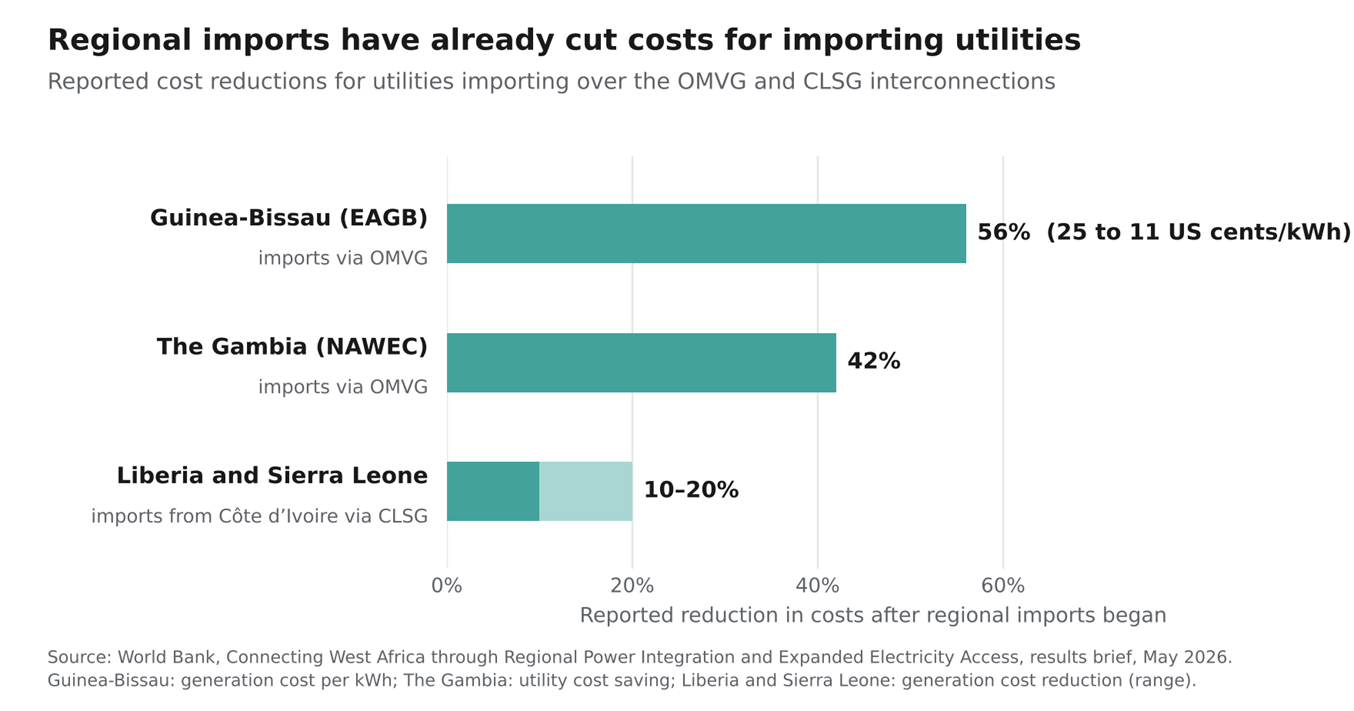
On regional integration, trade in West Africa remains modest relative to the infrastructure now in place: more than 4,000 km of high-voltage lines connect national grids, yet only about 8% of the region’s electricity is traded across borders. Where imports have grown, importing utilities have benefited substantially (Figure 2), although these gains predate the new methodology and reflect the benefits of regional trade in general. The ECOWAS master plan for 2019–2033envisages about 15,500 MW of new generation and 22,900 km of high-voltage lines, at an estimated cost of USD 36.4 billion, of which about USD 10.5 billion is for transmission. A predictable, usage-based allocation of transmission costs is a precondition for financing that pipeline and for the regional Day-Ahead Market, whose tariffs regulators validated in late 2025 but which had not launched by October 2026; WAPP expects the next phase of the regional electricity market to start in early 2027.
Reported benefits of regional trade for utilities importing over the OMVG and CLSG interconnections, before the new methodology took effect (metrics differ: generation cost per kWh for Guinea-Bissau, utility cost saving for The Gambia and a range of generation-cost reductions for Liberia and Sierra Leone)
On utility viability, allocating the annual cost of regional assets independently of trade volumes gives transmission owners a predictable revenue stream, the regional US dollar fund protects recipients from currency risk, and annual reconciliation lets importing utilities budget against their measured use of the network. The framework also places new demands on national utilities, because compensation must be recovered through domestic tariffs that remain below cost in several countries, payment discipline will be enforced through regional sanctions, and obligations denominated in US dollars leave payers whose revenues are in local currencies to carry the exchange-rate risk. Compact commitments on cost-reflective tariffs and revenue collection will therefore largely determine whether the regional allocation is paid in practice.
Design lessons for other power pools
The principles behind WAPP’s reform are transferable, but its institutional arrangements are not automatically so. The Southern African and Eastern Africa Power Pools, and the transmission pricing arrangements needed for the African Single Electricity Market (AfSEM), can apply the same principles, but method, governance and timetable must reflect each region’s legal authority, market structure and implementation capacity.
WAPP’s experience suggests three lessons. The first is that sound principles make political agreement easier, since once stakeholders accepted Average Participations as consistent with those principles, the method itself drew relatively little disagreement, and negotiation concentrated on parameters such as the split-key. The second is that distributional effects should be modelled and shared early, so that countries understand how proposed rules affect their costs and revenues before adoption. The third is that transitional mechanisms, including a phased split-key, ex-post reconciliation and a managed exit from legacy contracts, can turn technical consensus into rules that countries are willing to adopt. Allocation rules also depend on creditworthy utilities and predictable national regulation, the focus of the companion article on regulatory harmonization in COMESA.
Conclusion
An equitable regime ultimately has to pass three tests: whether the allocation is cost-reflective, based on use or benefit rather than on contracts; whether revenue is adequate and payment secure, so that transmission owners and lenders can rely on recovering approved costs; and whether the transition is politically manageable, so that countries whose revenues change can accept the rules. WAPP’s design appears to meet the first test and has made credible provisions for the second and third. By supporting regional integration and utility viability, it also contributes to Mission 300 objectives. Whether the provisions work in practice will become clear from the first annual reconciliation of allocations against metered flows, from payment records under the new sanctions regime, and from the mid-transition review of allocation accuracy and payment timeliness recommended above.
Add New Comment