
Bridging the Currency Gap: Unlocking Africa's Domestic Capital for Energy Infrastructure
Introduction
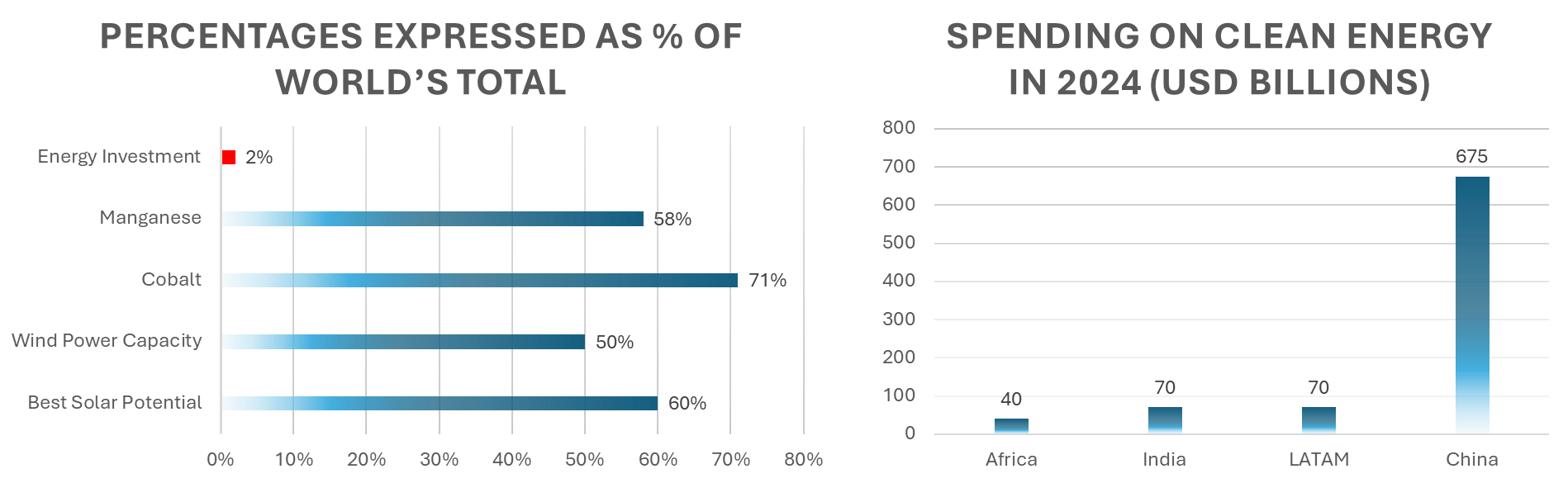
Africa holds an extraordinary share of the resources that will shape the global energy transition. According to the African Development Bank (AfDB) and KPMG’s New Mechanism for Mitigating Currency Risk to Support Africa’s Energy Transition report, the continent accounts for an estimated 60% of global prime solar irradiation potential and around half of worldwide wind power capacity, while holding some of the largest deposits of transition-critical minerals: approximately 71% of global cobalt reserves, 76% of platinum, and 58% of manganese. Together, these renewable-energy resources and mineral reserves give Africa a central role in the global shift to cleaner energy, from power generation to the manufacture of batteries and other clean-energy technologies. Yet, despite this potential, Africa attracted only about 3% of global energy investment and a mere 2% (roughly USD 40 billion) of worldwide spending on clean energy in 2024. This compares with around USD 70 billion in clean energy investments each in India and Latin America, and approximately USD 675 billion in China.
Africa's Paradox – share of global totals (renewable energy potential and mineral reserves) vs. share of global clean energy investment (Source: Author's own elaboration based on AfDB-KPMG report)
The African Development Bank (AfDB) estimates that the continent will need around USD 190 billion annually until 2030 to meet Sustainable Development Goal 7: access to affordable, reliable, sustainable, and modern energy. Bridging this gap will require rethinking how Africa finances its infrastructure, particularly by mobilizing domestic resources and mitigating the currency risks that have long inflated the cost of capital.
The burden of Foreign Exchange dependence
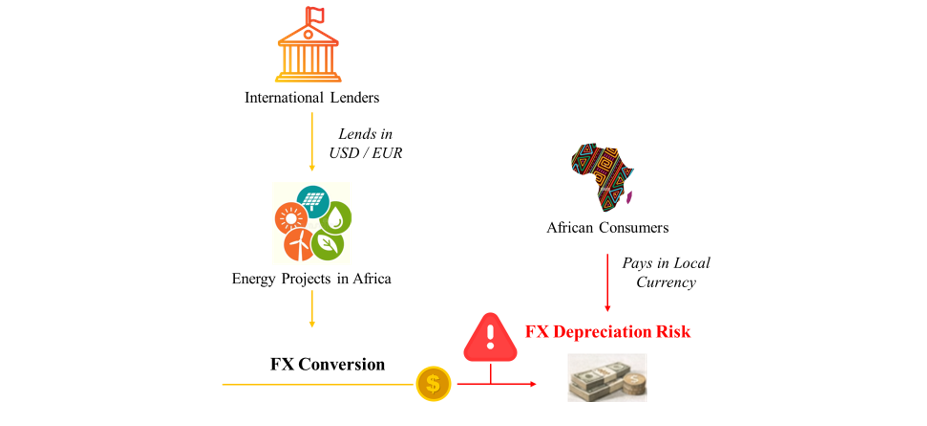
As a joint perspective published by The Currency Exchange Fund (TCX) and the AfDB posits that the overwhelming majority of Power Purchase Agreements (PPAs) in Africa remain denominated in US dollars or Euros, particularly outside South Africa. This dependence is driven by shallow local financial markets and the continued dominance of international lenders, thereby creating a structural vulnerability - projects earn revenue in local currency, while debt service is often owed in USD or euros. When the domestic currency depreciates, repayment obligations can rise sharply in local-currency terms, weakening project economics and increasing pressure on utilities and off-takers. Figure 2 below illustrates just how sharply several major African currencies have depreciated against the US dollar since 2020.
How African local currencies have performed against the US dollar, 2020–2026, indexed to 2020 = 100 (Source: AEP team's own elaboration based on central bank and exchange-rate-history data; CFA franc shown as a EUR-pegged comparator). Figures are period exchange rates, not parallel-market rates, and 2026 reflects mid-year data.
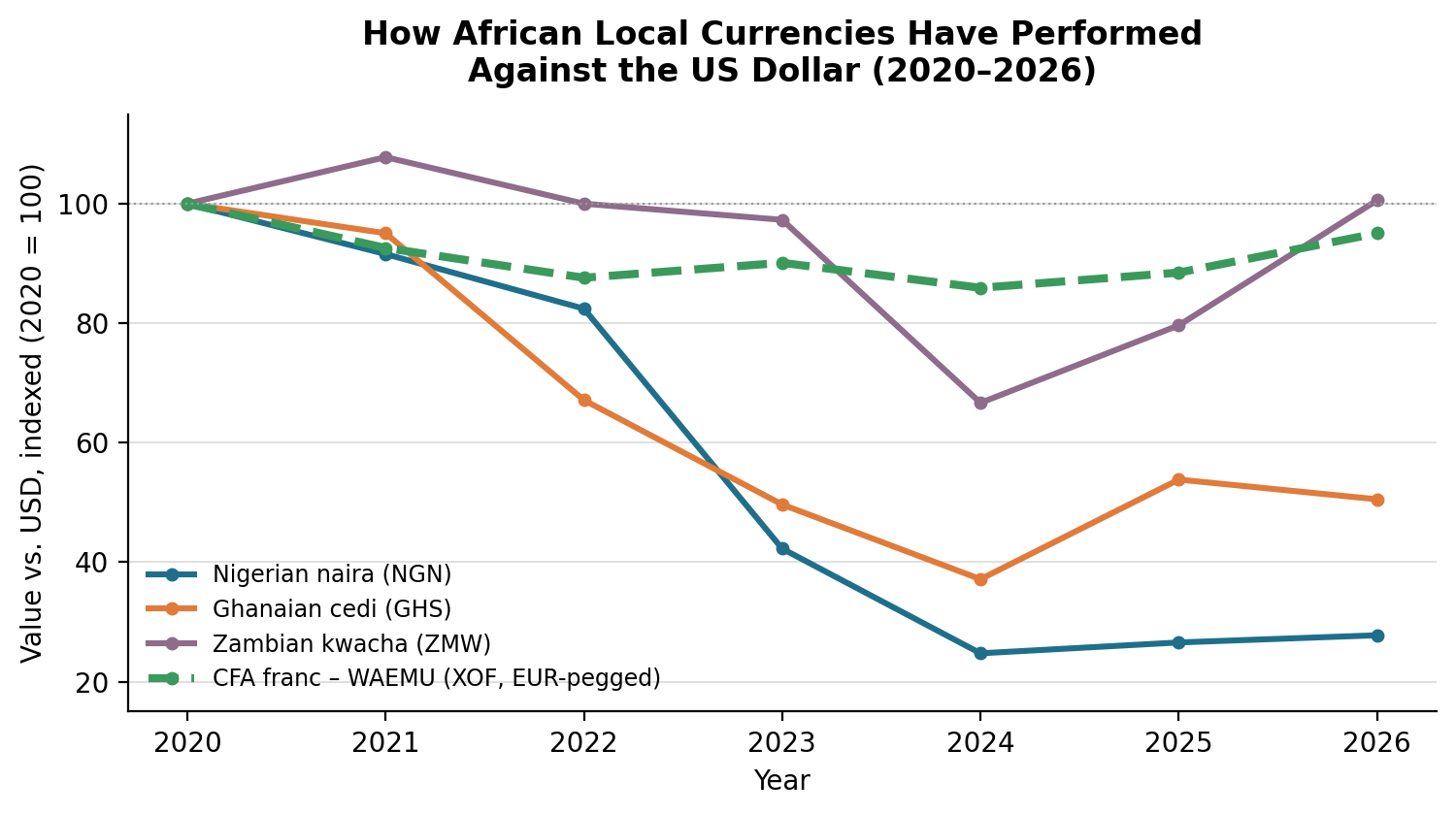
This mismatch has destabilized utilities and constrained private investment in several countries. Between 2016 and 2020, for example, local currency depreciations in Nigeria, Ghana, and Zambia eroded energy companies' capacity to service foreign-denominated debt, which led to fiscal stress and project delays. Between 2016 and 2024, the Nigerian naira depreciated approximately 483% against the dollar, Ghana's cedi fell 263%, and Ethiopia's birr 280% (TCX, AfDB, 2025). For any 20-year dollar-denominated PPA signed at the start of that period, the real cost to the off-taker in local currency terms has multiplied several times over. Exchange-rate volatility remains a major barrier to sustainable project finance, often deterring private investors and increasing financing costs across energy markets.
The Currency Mismatch Problem (Source: Author’s own elaboration based on AfDB-KPMG report)
Proof points: domestic capital already in motion
The case for making this shift is already well evidenced. According to the Energy for Growth Hub, modelling across Kenya, Nigeria and Ghana indicates that shifting project finance towards local currency, when complemented by appropriate policy support and de-risking tools, can reduce capital costs by up to 31% and electricity costs by up to 29% for African energy projects. Real cases back this up. In South Africa's Renewable Energy Independent Power Producer Procurement Programme (REIPPPP), reforms allowed local banks to fund around 70% of project debt in rand. This in turn contributed significantly to driving solar tariffs down, along with declining production and technology costs and heightened competitive bidding under successive procurement rounds, by over two-thirds between 2011 and 2023. In Nigeria, the establishment of InfraCredit helped pave the way for long-term local currency financing for infrastructure projects by mobilizing institutional capital and working with regulators to strengthen the enabling environment. Since inception in 2017, InfraCredit has raised NGN 324 billion (c. USD 236 million) to underwrite naira-denominated infrastructure bonds, with NGN 177 billion (c. USD 130 million) mobilized from pension funds.
Recognizing currency mismatch as a structural constraint on Africa’s energy transition, the AfDB and its partners have moved beyond diagnosis by deploying a range of distinct financing solutions, including direct local-currency investments, risk-sharing facilities, partial credit guarantees, concessional support for hedging and receivables-backed securitization. These instruments address different barriers and should not be conflated. Local-currency debt can reduce currency mismatch by aligning project revenues and debt-service obligations, whereas concessional or blended finance may principally reduce financing margins and improve tariff affordability without necessarily removing the borrower’s foreign-exchange exposure.
Nigeria’s pension industry, the second largest on the continent, illustrates the potential of institutional capital. In 2018, the AfDB invested the naira equivalent of USD 10 million in the Nigeria Infrastructure Debt Fund (NIDF) directly from the Bank’s own balance sheet. The investment was made in local currency. At the time, NIDF was Nigeria’s first listed local-currency infrastructure debt fund, providing institutional investors with a transparent and liquid route into an otherwise illiquid asset class. The Fund has grown to over NGN 135 billion in assets under management and reports mobilizing more than USD 600 million equivalent in infrastructure investment, including the financing of over 134 MW of power-generation capacity.
The AfDB’s 2020 local-currency financing report provides additional insight into how this market was developed. At the time, 19 Nigerian pension funds had already invested in NIDF, but the Fund reported conducting more than 400 meetings to build investors’ understanding of infrastructure credit and secure their participation. This experience demonstrates that creating an investable vehicle is only part of the solution: sustained engagement, technical capacity building, transparent performance data and familiarity with the asset class are also required to mobilize domestic institutional capital at scale.
Another notable AfDB-backed mechanism is the Leveraging Energy Access Finance Framework (LEAF), supported by the Green Climate Fund. GCF approved USD 170.9 million for LEAF as part of an overall USD 900 million programme intended to expand decentralized renewable-energy financing in Ethiopia, Ghana, Guinea, Kenya, Nigeria and Tunisia. Its interventions include risk-sharing and credit-enhancement mechanisms designed to reduce lender exposure and unlock commercial and local-currency financing for mini-grids, solar home systems and commercial and industrial solar projects. Within the broader framework, the USD 100 million LEAF Risk-Sharing Facility with the African Guarantee Fund uses counter-guarantees and partial credit guarantees to encourage local financial institutions to enter these markets.
Receivables-backed finance offers another practical route for mobilizing domestic capital. In Côte d’Ivoire, NEoT Offgrid Africa, an investment platform managed by New Energy of Things Capital (NEoT Capital), established NEoT CI as a special-purpose securitization vehicle. NEoT CI purchases solar home systems and the associated customer receivables from Zola EDF Côte d’Ivoire (ZECI), a joint venture between EDF and Zola Electric that sells and maintains pay-as-you-go solar systems for off-grid households. To finance these purchases, NEoT CI secured an XOF 11.8 billion local-currency loan from Société Générale Côte d’Ivoire, supported by an AfDB partial credit guarantee and a separate guarantee from Crédit Agricole CIB. The broader NEoT–ZECI securitization programme aimed to finance the deployment of more than 100,000 solar home systems, primarily in rural areas.
SEFA’s role in this local-currency financing landscape can be very catalytic. A clear example is the XOF 60 billion social bond for Phase II of Côte d’Ivoire’s Programme Électricité Pour Tous (PEPT). SEFA’s concessional resources were used to reduce the cost of TCX cross-currency swaps supporting the transaction, while the bond securitized electricity-connection receivables in local currency to finance approximately 423,000 new connections for low-income households. This structure converts future customer payments into investable local-currency securities and demonstrates how concessional support can make currency hedging and longer-term domestic financing more affordable.
Beyond these AfDB-backed mechanisms, Nigeria’s First Electric transaction provides another example of the domestic market in action. Supported by InfraCredit and the UK-funded Climate Finance Blending Facility, the transaction mobilized local-currency debt for 20 off-grid mesh-grid networks expected to serve more than 5,000 households and businesses. Concessional first-loss capital, construction-period finance and InfraCredit’s investment-grade guarantee enabled domestic investors to participate while reducing the credit and financing risks associated with a relatively small decentralized-energy project.
Together, these examples demonstrate what domestic capital mobilization looks like in practice. Direct local-currency investments can connect pension assets with infrastructure projects; guarantees and risk-sharing facilities can reduce lender exposure; securitization can transform local-currency receivables into investable securities; and concessional resources can lower borrowing or hedging costs. The critical distinction is that foreign-exchange risk is reduced only where financing is denominated in, or effectively hedged into, the currency of project revenues. Interest-rate blending alone may improve affordability while leaving residual currency risk with the borrower. By applying these instruments according to the specific constraints of each market, the AfDB and its partners are building the track record, institutional capacity and investable pipeline required for deeper domestic energy-finance markets.
Responding to the scale of the challenge
The need for innovation is urgent: Africa currently spends only 3.5% of its GDP on infrastructure (half the Asian average) while private investors provide barely 10% of total financing. The region's debt-to-GDP ratio has nearly doubled in a decade to 66%, and most public borrowing for infrastructure development remains foreign-currency denominated. This situation leaves countries highly exposed to global interest-rate movements and currency swings.
Scaling up local-currency financing has the potential to attract more sustainable investment into clean-energy projects. The initiative is consistent with Mission 300, the joint effort of the African Development Bank and the World Bank to connect 300 million Africans to electricity by 2030, and with the Bank's Four Cardinal Points strategic vision, particularly its first pillar, enhancing access to capital by mobilizing Africa's own financial resources.
However, local commercial banks remain indispensable to scaling local-currency infrastructure finance. Their domestic deposit bases, established borrower relationships and knowledge of local markets should position them to originate, assess and monitor local-currency lending, particularly for smaller distributed-energy and commercial and industrial projects that may be unsuitable for international lenders or capital-market issuance.
Their participation nevertheless remains constrained. The AfDB’s 2020 local-currency financing study, informed by consultations with 163 organizations and detailed assessments of Ghana, Kenya, Nigeria and Tunisia, found that commercial banks generally had limited appetite for off-grid energy projects. Many preferred relatively liquid and high-yielding government securities, restricted lending to established corporate clients and lacked sufficient familiarity with renewable-energy technologies, project-finance structures and solar-as-a-service business models. Short-term deposit bases also limited their ability to offer the longer tenors required by infrastructure projects: mini-grid developers consulted for the study frequently required debt with tenors of up to ten years and continued grant support covering 30 - 50% of project costs.
These constraints are reinforced by volatile inflation and interest rates, currency instability and, where implemented, Basel III capital and stable-funding requirements that can make long-tenor, illiquid project-finance exposures more balance-sheet intensive. The report also found that banks often treated guarantees primarily as substitutes for collateral rather than as a basis for reducing interest margins, meaning that credit enhancement alone did not necessarily produce affordable financing.
Unlocking local-bank participation will therefore require more than guarantees. Long-term funded local-currency facilities, appropriate risk-sharing arrangements, technical assistance, standardized project documentation, better performance data and aggregation of smaller projects are also needed to improve pricing, extend tenors and strengthen banks’ capacity to assess energy investments.
NIDF provides a channel for institutional capital beyond conventional bank balance sheets; LEAF shares credit risk with financial intermediaries; and PEPT demonstrates how local receivables can be converted into longer-term capital-market instruments. As procurement frameworks increasingly consider currency structure from the outset, these complementary mechanisms can help local banks and domestic investors respond to growing demand provided by macroeconomic stability, deeper financial markets and sustained institutional capacity building.
Add New Comment