
Energy Access for Productive Use

Introduction
Electricity access is often reported as a connection statistic: how many homes were reached, how many poles were erected, how many villages were “electrified.” However, this framing is too narrow for countries where firms still rely on diesel generators, farm output is lost for lack of cold storage, and public services cannot function without steady power. Sub-Saharan Africa has approximately 600 million people without electricity access, the world's largest energy-access gap, and annual electrification rates are being outpaced by population growth in several countries.
Mission 300, the joint African Development Bank and World Bank initiative to connect 300 million people in Sub-Saharan Africa by 2030, represents the most ambitious and best-resourced response to that gap in the continent's history. As of June 2026, the initiative has connected over 50 million people across 40 countries, with 30 National Energy Compacts launched and nearly USD 15 billion committed by the AfDB and World Bank alone. But Mission 300's own framing makes clear that the strategic question is no longer simply whether power reaches people, it is whether it reaches enterprise. Electricity is explicitly tied to incomes, jobs, economic growth, irrigation, processing, and private sector development. The initiative's five target countries with the largest unelectrified populations - Nigeria, the Democratic Republic of Congo (DRC), Ethiopia, Tanzania, and Uganda - are also the same five with Africa's largest job gaps.
These five countries are not a uniform group, and the enabling conditions for Productive Use of Energy (PUE) differ sharply across them. Nigeria benefits from a relatively mature regulatory framework, deep private-sector participation, and large pools of concessional and commercial finance - conditions that make enterprise-anchored mini-grid design tractable at scale, and which is why this piece uses it as its central case study. DRC and Ethiopia sit at a starkly different starting point, where basic infrastructure reach, security, and public-sector financing capacity are still the binding constraint on PUE, ahead of commercial design (more on both below, in Enabling Conditions). Tanzania and Uganda sit somewhere between the two: Tanzania has seen a five-fold acceleration in its connection pace under Mission 300, while Uganda continues to combine relatively strong grid extension with a large unconnected rural population - both still earlier in translating new connections into enterprise demand than Nigeria is.
The implication for PUE strategy is that a single template will not travel across all five countries. In Nigeria-type contexts, the binding constraint is largely commercial design: getting enterprise demand embedded into bankable mini-grid business models. In DRC and Ethiopia-type contexts, the binding constraint is more often basic infrastructure reach, security, and public-sector financing capacity, meaning PUE interventions must be sequenced after, or alongside, far more fundamental investments in grid and mini-grid build-out, with demand-creation programs designed around uncertain, slow-growing, and geographically dispersed loads.
What is Productive Use of Energy (PUE)?
Productive Use of Energy refers to electricity used as an input into income-generating or service-delivering activity, rather than electricity consumed only for basic household purposes such as lighting, phone charging, or entertainment.
The distinction from residential access is therefore not semantic. Household access improves welfare and PUE changes local economic structure. A cold room reduces post-harvest losses. A milling machine captures value locally instead of exporting it elsewhere. A water pump can expand irrigated production. A clinic or school with dependable electricity can provide higher-value services. Mission 300 underlines this broader logic by linking electricity to irrigation systems, commercial farming, processing plants, and digital networks.
PUE also improves the economics of distributed energy. Recent research from Nigeria shows that small and medium-sized enterprises place higher value on daytime electricity and that willingness to pay rises sharply for high-capacity service, relative to household preferences. This pattern suggests a more commercially attractive load profile for mini-grids when enterprise demand is embedded from the start. The Nigeria Electrification Programme makes the same point operationally: its Results-Based Financing window aims to encourage developers to make productive use and energy-efficient appliances part of their overall mini-grid viability strategy.
Mini-grid systems designed only around low-consumption evening household demand often struggle to generate robust revenue. Systems designed around households and small enterprises together achieve higher load utilization, stronger daytime demand, and greater long-term financial viability. AMDA's 2024 Benchmarking Africa's Minigrids Report documents this shift in practice: the proportion of AMDA members' mini-grids serving 500+ residential connections rose from 8% in 2022 to 30% in 2024, driven in part by the integration of commercial and productive users that improve site economics.
The commercial logic: A mini-grid designed around household demand alone faces thin margins. One designed around productive users, mills, cold rooms, workshops, earns more per kWh, operates during the day, and builds bankable anchor load. PUE is thus, not just a development objective; it is a revenue model.
The Scale of Opportunity
Africa's agricultural sector employs over 60% of the population and accounts for roughly one-third of continental GDP. Yet energy use in Africa, which hosts around 15% of the global population and faces growing food demand, has remained largely constant, accounting for only about 4% of global energy consumption in agri-food systems.
The consequences are visible in the losses. Africa's post-harvest losses cost an estimated USD 4 billion per year: approximately 30% of grain production and up to 50% of more perishable products are lost due to poor storage, inadequate cold chain infrastructure, and lack of processing capacity. In Kenya alone, an estimated 40-50% of food is lost or wasted across the full farm-to-fork chain, twice the global average, representing USD 1.5 billion per year in losses.
Solar-powered PUE technologies are demonstrably capable of addressing this gap. Technologies such as solar irrigation, cold storage, and agro-processing can reduce post-harvest losses by up to 50%, raise yields, and open new markets for premium products. The region's electricity demand for agricultural activities alone is projected to double to 9 GW by 2030, under a scenario-based projection rather than a confirmed forecast, as food markets grow - a demand signal that, if captured by distributed renewable energy systems, could transform the commercial model of mini-grids across the continent.
Documented Economic Impact of Mini-Grid PUE Interventions
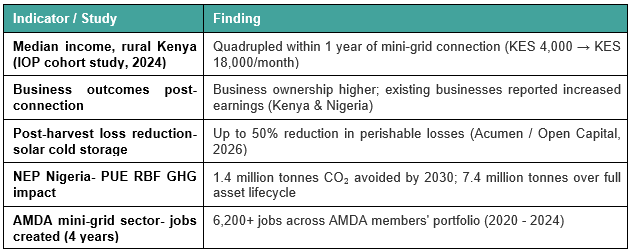
Sources: IOP Science / Environmental Research: Infrastructure and Sustainability (2024); Acumen / Open Capital Advisors (2026); GEAPP (2022); AMDA BAM Report (2024).
Case Study: Nigeria Electrification Programme
Nigeria's electrification programme offers one of the clearest African examples of how to move PUE from rhetoric into project architecture. The Nigeria Electrification Programme, originally launched as the Nigeria Electrification Project with about USD 550 million in World Bank and African Development Bank financing, is explicitly private-sector driven and is designed to serve households, Micro, Small & Medium-sized Enterprises (MSMEs), educational facilities, and healthcare facilities through mini-grids, standalone solar systems, rooftop solar, captive power plants, and productive-use appliances. Crucially, its formal development objective is not household access alone, but increased electricity access for households and MSMEs through private-sector-led distributed renewable energy generation.
The first layer of implementation was on the supply side. Under the African Development Bank mini-grid component, the Rural Electrification Agency (REA) structured a Solar Hybrid Mini Grid for Economic Development window around sites with high economic growth potential. Developers were invited to build, own, and operate systems that would energize households, local enterprises, and public institutions. The target for this component is 105,000 households and 20,000 MSMEs through a USD 46 million funding mechanism. REA also packaged sites into state-based lots and awarded grants competitively through a minimum subsidy tender, an approach meant to create economies of scale in procurement and more efficient operations.
The second layer was on the demand side. NEP did not assume that productive demand would emerge automatically after poles and panels were installed. It created a dedicated Results-Based Financing facility for Productive Appliances and Equipment under the AfDB component. This window is designed to increase productive use in remote communities by improving access to efficient electric productive equipment, pushing developers to incorporate productive use into mini-grid strategy, and activating the market for productive appliances and equipment. The facility carries USD 19 million in results-based financing to private-sector providers, with targets of 24,500 MSMEs and 1,050,000 people benefiting from improved energy services; 20% of MSME and beneficiary targets are earmarked for women-headed enterprises and households.
The third layer was institutional. NEP paired finance with technical assistance and capacity building for REA and sector stakeholders in order to strengthen project delivery and the broader off-grid ecosystem. This matters because PUE is not delivered by hardware alone. It depends on market development, implementation discipline, developer capacity, and the ability to connect energy planning with local enterprise development.
The most intellectually important lesson, however, comes from how the programme adapted over time. The NEP case study explains that early interventions initially emphasized subsidies for productive-use equipment, but the programme learned that equipment-only support often delivered short-lived gains. Maintenance, replacement costs, and weak business revenues limited durability. The strategy then shifted toward supporting commercially viable enterprises that could generate jobs, incomes, and sustained electricity demand, including rice milling, greenhouse agriculture, and shea butter processing. That pivot is significant: it reframed PUE from an appliance-distribution exercise into an enterprise-development strategy.
Current programme reporting suggests that this enterprise lens is no longer peripheral. The official NEP platform now describes the programme as powering homes, institutions, and businesses; notes that productive-use appliances are part of its sustainability logic; and reports 11,400 MSMEs already provided with new or improved electricity services.
Enabling Conditions for PUE at Scale
The first enabling condition is reliability. Productive demand is far less tolerant of outages than residential demand. A household can postpone some uses; a mill, a refrigerated value chain, or a digitally enabled enterprise cannot. Mission 300 repeatedly stresses reliable, sustainable, and affordable electricity for businesses and public services, while evidence from Nigeria shows SMEs value daytime service and higher-capacity connections especially strongly. PUE, then, is not compatible with highly intermittent supply. Reliability is the business model.
Closely related is a second condition: sequencing PUE investment to match where a country actually sits on the infrastructure curve. DRC illustrates this starkly. Its national electrification rate is estimated at only 22%, the country spans 2.3 million km² across nine borders, and over 384 million people in Sub-Saharan Africa live in World Bank-classified conflict-affected states. A 2026 study of mini-grids in conflict-affected North Kivu found connection rates ranging from 75% in the regional hub of Goma to as low as 25% in surrounding rural areas, with electricity demand recovering within two years even after a conflict-driven disruption - evidence that PUE is achievable in fragile settings, but only when paired with active demand development, land-tenure resolution, and public-private coordination. Ethiopia combines a much higher urban electrification rate (94%) with a vast unconnected rural population, roughly 60 million people, and a National Electrification Programme budgeted at approximately USD 6 billion - a sum that exceeds government financing capacity on its own and leaves off-grid and mini-grid components dependent on donor-backed programmes such as ELEAP, which had connected only 11 mini-grids (20,000 people) as of early 2025 against a target of reaching 10 million additional Ethiopians by 2026. In both cases, PUE cannot be the first investment; it has to be sequenced alongside, or just behind, more fundamental build-out of grid reach, security, and financing capacity.
The third condition is policy design that treats demand creation as a legitimate public objective. Nigeria's example is telling: competitive procurement lowered subsidy requirements for mini-grid deployment, while the productive-appliance facility used targeted public finance to deepen enterprise demand and improve mini-grid viability. Women-inclusive beneficiary targets further signal that PUE policy can be both commercially rational and socially intentional. Under Mission 300 more broadly, National Energy Compacts are meant to align reforms, investment, and measurable access outcomes in exactly this sort of coordinated fashion.
The fourth condition is technical and institutional support. Energy systems serving agro-processing, cold chains, workshops, clinics, or ICT services must be designed around actual load profiles, appliance requirements, and local market realities. NEP's technical assistance windows recognize this by supporting project management, stakeholder capacity, and off-grid ecosystem development. In practice, scalable PUE needs more than concessional capital; it needs developer capability, local supply chains, and enough implementation support to translate electricity into productive demand.
The fifth condition is a serious private-sector role. Nigeria's programme is explicitly private-sector driven. Its mini-grid component uses build-own-operate models; its World Bank and AfDB windows rely on competitive tenders, performance-based grants, and results-based financing; and its productive appliance support is channeled to private providers rather than managed as a purely public distribution scheme. Mission 300 adopts the same logic at continental scale and explicitly identifies private investment as critical to mini-grids and distributed renewable energy. PUE scales fastest when public institutions set the rules, de-risk the market, and let firms build bankable demand.
Moving Forward
The real promise of electrification materializes when energy meets enterprise. Productive Use of Energy turns access from a welfare metric into a growth strategy: it raises rural incomes, strengthens value chains, improves the utilization and bankability of mini-grids, and makes distributed renewable energy more economically durable. Mission 300's emphasis on jobs, agriculture, processing, and private investment makes clear that Africa's next electrification chapter cannot stop at the socket.
The Nigeria Electrification Programme shows what serious PUE implementation looks like in practice: mini-grids targeted at high-growth sites, explicit MSME objectives, a dedicated results-based facility for productive appliances, competitive procurement, technical assistance, and a strategic shift from subsidizing isolated equipment toward enabling viable enterprises. For partners looking to co-invest under Mission 300, this is the deeper lesson. The most transformative energy system is not the one that merely delivers electrons. It is the one that helps communities turn electricity into income, resilience, and structural economic change.
Add New Comment